
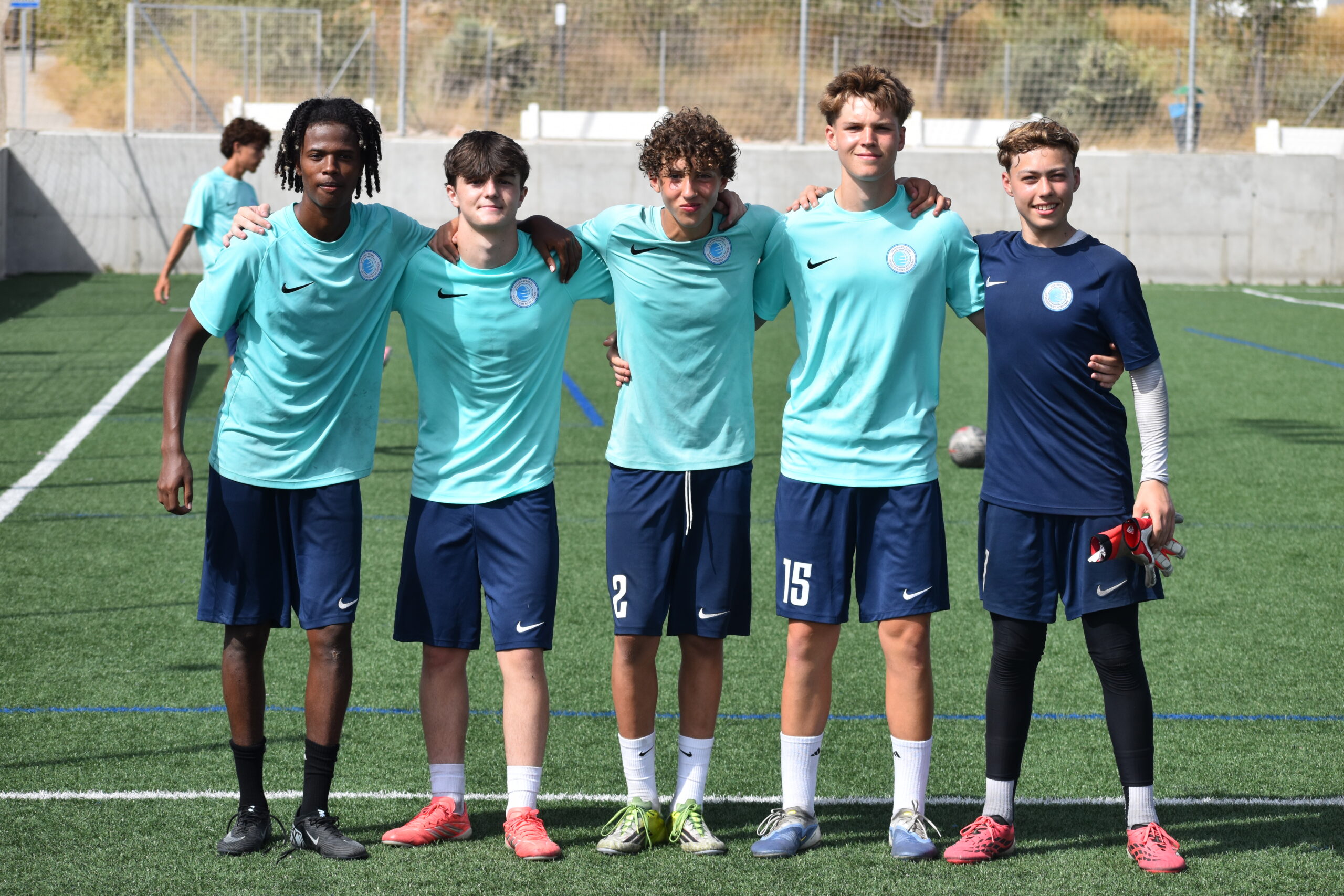
Most people picture an international soccer academy as ninety minutes of drills a day and nothing else. It isn’t. At IDA’s global campuses, a student’s day is split almost evenly between the pitch, the classroom, and the dorm. And it’s that balance, not just the training hours, that shapes whether a young player is actually ready for what comes after the academy. Here’s what a real day looks like, and why the lifestyle matters as much as the coaching.
A typical day at an international soccer academy runs on a fixed rhythm: early training, a full academic school day, a second training or recovery session, and structured evening time for homework, meals, and rest.
IDA students are usually up before 7 a.m. for a light activation session which includes mobility work, ball touches, and sometimes a short conditioning block. All before breakfast and the start of the academic day. Classes run through the late morning and early afternoon, taught by faculty who understand that their students may be jet-lagged from a weekend tournament or nursing a minor knock. Mid-afternoon is when the main training session happens: tactical work, positional drills, and small-sided games under coaches who are building toward a season, not just a practice. Evenings are for recovery, study hall, and downtime with teammates who, by this point, are more like housemates.
Academics at IDA are built around the training schedule, not squeezed around it. Students follow an accredited curriculum with class sizes and pacing designed for athletes managing travel, fixtures, and fatigue.
This is the detail that separates a serious academy from a training camp with a school attached. Coursework is designed to keep pace with an accredited standard so students can transition to university or a professional pathway without a gap in their education. Teachers coordinate with coaching staff around match schedules, and study hall is treated with the same seriousness as a recovery session, because for the vast majority of students, education is the more certain long-term outcome, even for those with real professional potential.
Dorm life at an international academy means shared rooms or small residence halls, house-parent or dorm-supervisor oversight, and a daily routine built around meals, study hours, and curfew. Closer to a boarding school than a typical youth sports program.
Students come from dozens of countries and time zones, and the campus becomes the thing that normalizes that. Meals are shared and often nutritionally planned around training load. Common rooms fill up in the evening with mixed groups — a 16-year-old from Sweden, a 17-year-old from Nigeria, a 15-year-old from Ohio — comparing homework and swapping stories about home. Homesickness is real, especially in the first few months, and most academies build in structured check-ins, video calls home, and older-student mentorship specifically to manage it. It’s one of the most understated parts of the experience, and one that families researching soccer boarding schools in Europe or elsewhere should ask about directly.
An international soccer club environment exposes players to a wider range of tactical styles, languages, and competition levels than a local club, which is often the biggest developmental difference families notice within the first season.
Training alongside, and against players raised in different footballing cultures changes how a young athlete reads the game. A student who grew up playing a direct, physical style at home might spend a season adapting to a possession-based system, or vice versa. That adjustment is uncomfortable in the short term and valuable in the long term: it’s closer to what scouts and coaches at the next level are actually looking for, and it’s difficult to replicate outside an international setting.
No, the real question isn’t whether a player or family is already independent and fully prepared, it’s whether they’re open to the shift and ready to grow into that independence as part of the experience.
Families sometimes assume they need to arrive at an international academy already equipped for the time zones, distance, and day-to-day autonomy that come with it, but that’s not realistic for most 14-to-18-year-olds, and it’s not the bar. What matters more is mindset: is the player genuinely open to being challenged outside their comfort zone, and is the family prepared to support that growth rather than expecting it to already be in place? Families who go in with that kind of openness tend to see the adjustment, whether academically, socially, and on the field, and go far more smoothly than those who focus only on the training and assume the rest will sort itself out.
Most students train in two sessions totaling roughly 2 to 3 hours per day, split between an early conditioning or technical session and a longer tactical session in the afternoon, with recovery and mobility work built in around match days.
Yes. Reputable academies run an accredited academic curriculum alongside training, with coursework designed to let students transition to university or continue their education regardless of their playing outcome.
Most students enroll between ages 14 and 18, though this varies by program and by country-specific schooling requirements.
If you’re weighing an international soccer academy for your family, the details above — the schedule, the academics, the dorm life — are exactly what to ask about on a call with our admissions team. Get in touch with IDA to talk through what a season actually looks like at one of our campuses.
Still have questions? Want to learn more? Fill out the form below to connect with an IDA representative. We look forward to hearing from you!